Units handling#
Units handling
Handling units in BDF relies on established resources like pint, QUDT, and EMMO. This mini notebook shows how to:
Resolve a unit from different identifiers (canonical label, machine-readable name, IRI, or raw string)
Convert pandas.Series between units (with metadata-aware inference)
Use unit overrides in plotting
import bdf
from bdf.units import resolve_unit, convert
# Retrieve the unit from the preferred label
print(resolve_unit("Voltage / V"))

# Retrieve the unit from the vendor specific label
print(resolve_unit("AhAccu#Ah"))

# Retrieve the unit from the BDF machine readable name
print(resolve_unit("specific_capacity_milliampere_hour_per_gram"))

# Retrieve the unit from the BDF IRI
print(resolve_unit("https://w3id.org/battery-data-alliance/ontology/battery-data-format#discharging_capacity_ah", as_string=True))
volt
ampere * hour
hour * milliampere / gram
Ah
# Read from a local file path
filepath = "../data/SINTEF__LiGrR2032__2024-04-30__25degC__Landt.csv"

df = bdf.read(filepath)
df.head()
  Test Time / s Voltage / V Current / A Step Index / 1  \
0         0.020      2.9215      0.0000              1
1        15.020      2.9215      0.0000              1
2        30.020      2.9214      0.0000              1
3        45.020      2.9214      0.0000              1
4        60.020      2.9213      0.0000              1

  Discharging Capacity / Ah Charging Capacity / Ah Ambient Temperature / degC
0                         0                      0                          0
1                         0                      0                          0
2                         0                      0                          0
3                         0                      0                          0
4                         0                      0                          0
# Convert units from the source data and save it as a new dataframe
import pandas as pd
df_converted = pd.DataFrame()

# time s -> h
df_converted["Test Time / h"] = convert(df["Test Time / s"], "h")

# voltage V -> mV
df_converted["Voltage / mV"] = convert(df["Voltage / V"], "mV")

# current A -> mA
df_converted["Current / mA"] = convert(df["Current / A"], "mA")

# capacity Ah -> mAh
df_converted["Charging Capacity / mAh"] = convert(df["Charging Capacity / Ah"], "mAh")

df_converted.head()
   Test Time / h  Voltage / mV  Current / mA  Charging Capacity / mAh
0       0.000006        2921.5           0.0                      0.0
1       0.004172        2921.5           0.0                      0.0
2       0.008339        2921.4           0.0                      0.0
3       0.012506        2921.4           0.0                      0.0
4       0.016672        2921.3           0.0                      0.0
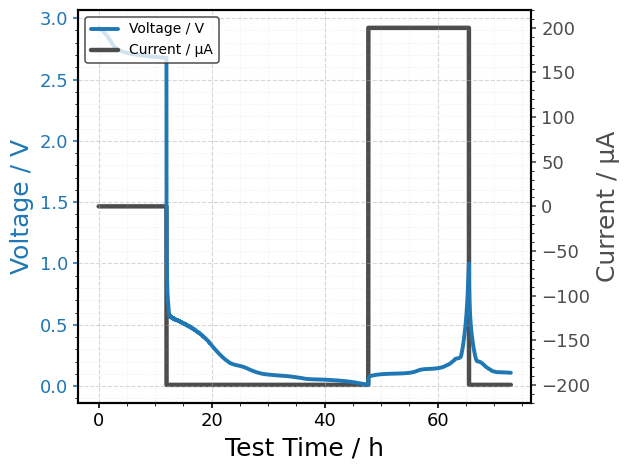
# Unit conversions can also be done directly in the plot function without additional steps
bdf.plot(
    df,
    xdata="Test Time / s", xunit="h",
    ydata="Voltage / V",
    yydata="Current / A", yyunit="µA"
)